

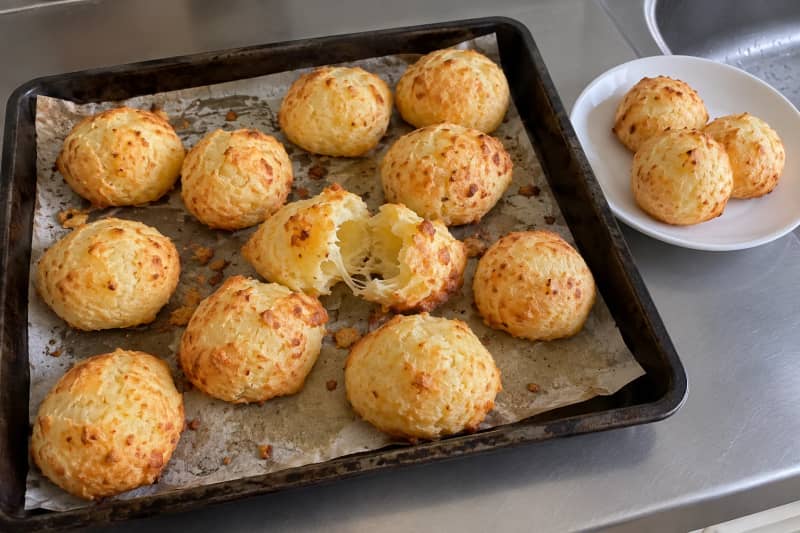
Ingredients
Quantities for 6 portions
Check ingredients as you prepare them. Changing portions resets the checks.
Method
- Preheat the oven to 200 °C and line two trays with baking paper. Coarsely grate the flamengo cheese and finely grate the parmesan.
- In a large bowl, mix the sour cassava starch, the tapioca starch (sweet polvilho) and the salt. In a small pan, bring 360 ml of water and 60 ml of the oil to the boil.
- Scald the starch: pour the boiling liquid over it gradually, stirring with a sturdy wooden spoon until there is no dry powder left. You get a lumpy, sticky dough.
- Leave it to cool for about 15 minutes until just warm (if it is hot, the eggs cook, the cheese melts and the dough will not rise).
- Add the cheeses and knead with your hands. Add the eggs one at a time, cracking each into a small bowl first, and knead well after each until absorbed. The dough is heavy, sticky and slightly lumpy: that is right.
- Oil your hands with the rest of the oil and roll golf-ball-sized balls (about 3 tablespoons of dough), spacing them out on the trays. To freeze, set the raw balls close together on a tray in the freezer until hard, then bag them.
- Bake for about 35 to 40 minutes until risen and golden. Serve hot. From frozen, bake at 180 °C without thawing, about 40 minutes.
Shopping tip
Sour cassava starch (polvilho azedo) is in Auchan's Brazilian aisle; sweet polvilho (tapioca starch) is in every chain. Minas meia-cura cheese is not sold here: the flamengo and parmesan mix works, and a mild grated queijo da Ilha or São Jorge can replace it and comes even closer to the original.
Where it fits in your week
Needs time. Better on a day without a rush.
Based on the cook time and portions the recipe states.
Put this recipe into a whole week
PlanMyMeals builds the week around your household's portions and turns it into a shopping list.
No card needed to try it.
Similar recipes
About this page
The photograph is AI-generated and illustrates the dish. It is not a record of a cook we carried out.
Times, portions and protein per portion are the recipe author's estimates, not laboratory measurements.